Monday, November 2, 2009

Description of Cabbage

Cabbage

From Wikipedia, the free encyclopedia

Cabbage
Cabbage and its cross section
Species
Brassica oleracea
Cultivar Group
Capitata Group
Origin
Mediterranean, 1st century
Cultivar Group members
Many; see text.
The cabbage is a popular cultivar of the species Brassica oleracea Linne (Capitata Group) of the Family Brassicaceae (or Cruciferae), and is used as a leafy green vegetable. It is a herbaceous, biennial, dicotyledonous flowering plant distinguished by a short stem upon which is crowded a mass of leaves, usually green but in some varieties red or purplish, which while immature form a characteristic compact, globular cluster (cabbagehead).
The plant is also called head cabbage or heading cabbage, and in Scotland a bowkail, from its rounded shape. The Scots call its stalk a castock, and the English call its head a loaf[citation needed]. It is in the same genus as the turnip – Brassica rapa L.
Cabbage leaves often display a delicate, powdery, waxy coating called bloom. The sharp or bitter taste sometimes present in cabbage is due to glucosinolate(s). Cabbages are also a good source of riboflavin.

History

Cabbage farmer in Gardena, California, 1951
The cultivated cabbage is derived from a leafy plant called the wild mustard plant, native to the Mediterranean region, where it is common along the seacoast. Also called sea cabbage and wild cabbage,  it was known to the ancient Greeks and Romans; Cato the Elder praised this vegetable for its medicinal properties, declaring that "It is the cabbage which surpasses all other vegetables."  The English name derives from the Normanno-Picard caboche (head), perhaps from boche (swelling, bump). Cabbage was developed by ongoing artificial selection for suppression of the internode length.

Uses

The only part of the plant that is normally eaten is the leafy head; more precisely, the spherical cluster of immature leaves, excluding the partially unfolded outer leaves. Cabbage is used in a variety of dishes for its naturally spicy flavor. The so-called "cabbage head" is widely consumed raw, cooked, or preserved in a great variety of dishes. It is the principal ingredient in coleslaw.

Cooked

Cabbage is often added to soups or stews. Cabbage soup is popular in Central and eastern Europe, and cabbage is an ingredient in some kinds of borscht. Garbure (from Provençal garburo) is a thick soup of cabbage or other vegetables with bacon. Cabbage may be an ingredient in kugel, a baked pudding served as a side dish or dessert. Cabbage is also used in many popular dishes in India.
Boiling tenderizes the leaves and releases sugars, which leads to the characteristic "cabbage" aroma. Boiled cabbage has become stigmatized because of its strong cooking odor and the belief that it causes flatulence. Boiled cabbage as an accompaniment to meats and other dishes can be an excellent source of vitamins and dietary fiber. It is often prepared and served with boiled meat and other vegetables as part of a boiled dinner. Harold McGee has studied the development of unpleasant smells when cooking brassicas and reports that they develop with prolonged cooking. According to Corriher's Compendium smell doubles when prolonging cooking from 5 to 7 minutes; for best results cabbage should be sliced thinly and cooked for 4 minutes.
Cabbage rolls, a type of dolma, are an East European and Middle Eastern delicacy. The leaves are softened by parboiling or by placing the whole head of cabbage in the freezer, and then stuffed with a mixture of chopped meat and/or rice. Stuffed cabbage is called holishkes in Yiddish. A vegetable stuffed with shredded cabbage and then pickled is called mango.
Bulgarian Cabbage
The largest cabbage dish ever made was on 19 December 2008 in the Macedonian city of Prilep, with 80,191 sarmas (cabbage rolls) weighing 544 kg (1,221 lbs).[6]
Bubble and squeak consists of potatoes and cabbage or, especially formerly, potatoes, cabbage and meat fried together. Potatoes and cabbage or other greens boiled and mashed together make up a dish called colcannon, an Irish Gaelic word meaning white-headed cabbage, grounded in Old Irish terms for cabbage or kale (cāl), head (cend or cenn) and white (find). In the American South and Midland, corn dodgers were boiled as dumplings with cabbage and ham.

Fermented and preserved

Cabbage is the basis for the German sauerkraut, Chinese suan cai and Korean kimchi. To pickle cabbage it is covered with a brine made of its own juice with salt, and left in a warm place for several weeks to ferment. Sauerkraut (colloquially referred to simply "kraut") was historically prepared at home in large batches, as a way of storing food for the winter. The word comes from German sauer (sour) and kraut (plant or cabbage) (Old High German sūr and krūt). Cabbage can also be pickled in vinegar with various spices, alone or in combination with other vegetables (turnips can be cured in the same way). Korean baechu kimchi is usually sliced thicker than its European counterpart, and the addition of onions, chillies, papaya, gin, minced garlic and ginger is common.

Medicinal properties

Cabbage, raw
Nutritional value per 100 g (3.5 oz)
Energy 20 kcal   100 kJ
Carbohydrates     5.8 g
- Sugars  3.2 g
- Dietary fiber  2.5 g  
Fat 0.1 g
Protein 1.28 g
Thiamine (Vit. B1)  0.061 mg   5%
Riboflavin (Vit. B2)  0.040 mg   3%
Niacin (Vit. B3)  0.234 mg   2%
Pantothenic acid (B5)  0.212 mg  4%
Vitamin B6  0.124 mg 10%
Folate (Vit. B9)  53 μg  13%
Vitamin C  36.6 mg 61%
Calcium  40 mg 4%
Iron  0.47 mg 4%
Magnesium  12 mg 3% 
Phosphorus  26 mg 4%
Potassium  170 mg   4%
Zinc  0.18 mg 2%
Percentages are relative to US
recommendations for adults.
Source: USDA Nutrient database
Cabbage is an excellent source of Vitamin C. It also contains significant amounts of glutamine, an amino acid which has anti-inflammatory properties. Cabbage can also be included in dieting programs, as it is a low calorie food.
It is a source of indole-3-carbinol, or I3C, a compound used as an adjuvant therapy for recurrent respiratory papillomatosis, a disease of the head and neck caused by human papillomavirus (usually types 6 and 11) that causes growths in the airway that can lead to death.
In European folk medicine, cabbage leaves are used to treat acute inflammation. A paste of raw cabbage may be placed in a cabbage leaf and wrapped around the affected area to reduce discomfort. Some claim it is effective in relieving painfully engorged breasts in breastfeeding women.
Fresh cabbage juice has been shown to promote rapid healing of peptic ulcers .

Varieties

Cultivar Unknown
There are many varieties of cabbage based on shape and time of maturity. Cabbages grown late in autumn and in the beginning of winter are called coleworts; their leaves do not form a compact head. "Colewort" may also refer to a young cabbage. The word comes from Latin caulis (stalk of a plant, cabbage) and Old English wyrt (herb, plant, root). A drumhead cabbage has a rounded, flattened head. An oxheart cabbage has an oval or conical head. A pickling cabbage, such as the red-leafed cabbage, is especially suitable for pickling; krautman is the most common variety for commercial production of sauerkraut. Red cabbage is a small, round-headed type with dark red leaves. Savoy cabbage has a round, compact head with crinkled and curled leaves. Winter cabbage will survive the winter in the open in mild regions such as the southern United States; the name is also used for Savoy cabbage. Other traditional varieties include "Late Flat Dutch", "Early Jersey Wakefield" (a conical variety) and "Danish Ballhead" (late, round-headed).

Production

China is the leader in production of cabbages followed by India and then the Russian Federation.
Top Ten Cabbage Producers — 11 June 2008[table 1]
Country Production (Tonnes) Footnote
 People's Republic of China 36,335,000 tonnes (35,761,000 LT; 40,052,000 ST) [table 2]
 India 5,283,200 tonnes (5,199,800 LT; 5,823,700 ST)
 Russia 4,054,000 tonnes (3,990,000 LT; 4,469,000 ST) [table 2]
 South Korea 3,000,000 tonnes (3,000,000 LT; 3,300,000 ST) [table 2]
 Japan 2,390,000 tonnes (2,350,000 LT; 2,630,000 ST) [table 2]
 Poland 1,375,900 tonnes (1,354,200 LT; 1,516,700 ST)
 Ukraine 1,300,000 tonnes (1,280,000 LT; 1,430,000 ST) [table 2]
 Indonesia 1,250,000 tonnes (1,230,000 LT; 1,380,000 ST) [table 2]
 United States 1,171,350 tonnes (1,152,850 LT; 1,291,190 ST)
 Romania 1,120,000 tonnes (1,100,000 LT; 1,230,000 ST) [table 2]
 World 69214270 [table 3]
  1. ^ "Food And Agricultural Organization of United Nations: Economic And Social Department: The Statistical Devision". Food and Agriculture Organization. http://faostat.fao.org/site/567/DesktopDefault.aspx?PageID=567#ancor. Retrieved 22 August 2009. 
  2. ^ a b c d e f g Food And Agricultural Organization estimate
  3. ^ Aggregate(may include official, semi-official or estimates)

Diseases

Among the many destructive diseases affecting the cabbage and often other members of the cabbage family are:
  • blackleg or black stem, caused by certain fungi (such as Phoma lingam); lesions in the stem near the soil surface become sunken and dark, and may girdle the stem
  • black ring or black ring spot, caused by a virus; necrotic, dark and often sunken rings on the leaf surface
  • black rot, caused by a bacterium (Xanthomonas campestris)
  • cabbagehead, abnormal growth in rutabagas caused by larvae of a gall midge (Contarinia nasturtii) feeding in basal part of the stalks
  • cabbage yellows or cabbage wilt, caused by a fungus (Fusarium oxysporum or Fusarium conglutinans); yellowing and dwarfing
  • clubroot, common, caused by a protist (Plasmodiophora brassicae), formerly classified as a slime mold; swellings or distortions of the root, followed often by decline in vigor or by death
  • wire stem, caused by a fungus (Pellicularia filamentosa or Rhizoctonia solani); constricted, wiry stem; similar to damping-off but attacks older seedlings

Pests

(See also List of Lepidoptera that feed on Brassica).
Many insects and other pests infest cabbage plants, among them:
  • cabbage worm, any of numerous insect larvae that feed on cabbages:
    • imported cabbage worm, the green larva of the cabbage butterfly or cabbage white, any of several largely white butterflies (family Pieridae, type genus Pieris, garden whites); they include a small cosmopolitan form (P. rapae), called also small white; a larger Old World form (P. brassicae), called also large white; a common North American form (P. protodice), called also checkered white or southern cabbage butterfly; and the green-veined white (P. napi), occurring in Europe and North America; larvae eat the leaves, are toxic to animals that consume the infested foliage
    • cabbage moth or diamondback moth (Plutella xylostella) larva, cosmopolitan of European origin
    • cabbage webworm (Hellula undalis), widely distributed, native to southern Europe or Asia, destructive in the U.S. Gulf states
    • cutworm
  • cabbage aphid, cabbage aphis or turnip aphid, widely distributed and destructive grayish green plant louse (Brevicoryne brassicae); lives on leaves
  • cabbage curculio, small weevil (Ceutorhynchus rapae); feeds within stems and on leaves
  • cabbage fly, cabbage root fly, root fly or turnip fly (Hylemya brassicae or Delia radicum, family Anthomyiidae), adult of small white cabbage maggot or root maggot that feeds in roots and stems
  • cabbage-leaf miner, small fly (Phytomyza rufipes) whose maggot is injurious
  • cabbage looper, pale green, white-striped measuring worm (Trichoplusia ni), larva of a moth of the family Noctuidae; feeds on leaves
  • cabbage seedpod weevil (Ceutorhynchus assimilis), small, grayish black; related to the cabbage curculio but smaller; feeds on and destroys developing seeds
  • cabbage snake, nematode worm of the family Mermithidae, parasitic on insect pests
  • gamma moth or silver Y moth (Plusia gamma) larva; migratory European noctuid moth having a bright silvery Y-shaped mark on each fore wing
  • harlequin cabbage bug (Murgantia histrionica), black stinkbug in tropical America and the warmer parts of the United States
  • serpentine leaf miner, grub that is the larva of a small fly (Liriomyza brassicae); eats out slender, white, winding burrows in the leaves
  • striped flea beetle (Phyllotreta striolata); has a yellow line on each elytron
  • zebra caterpillar, larva of an American noctuid moth (Ceramica picta); light yellow with a broad black stripe on the back and lateral stripes crossed with white

Related Brassica varieties and species

Besides cabbage proper, the species Brassica oleracea has many distinctive cultivars which are commonly known by other names. They include: broccoli (Italica Group); Brussels sprouts (Gemmifera Group), whose edible small green heads resemble diminutive cabbages; cauliflower (Botrytis Group), whose flower cluster is used as a vegetable; Chinese kale or Chinese broccoli (Alboglabra Group); kale or spring greens, a very hardy cabbage (Acephala group) that has curled, often finely cut leaves which do not form a dense head, and that some consider to be the original form of the cultivated cabbage; collard greens, a type of kale; and kohlrabi (Gongylodes Group), having an edible stem that becomes greatly enlarged, fleshy and turnip-shaped. Hybrids include broccolini (Italica × Alboglabra Group), broccoflower (Italica × Botrytis Group) and choumoelliera or marrow cabbage (cabbage, kohlrabi and kale).
There are two species of Chinese cabbage (lettuce cabbage, pakchoi, pechay) from Asia that somewhat resemble cabbage and are widely used as greens: Brassica chinensis, bok choy or celery cabbage, which forms a loose, chardlike head of dark green leaves, and Brassica pekinensis, or pe-tsai (peh-tsai), forming an elongated compact head of broad, light green leaves. Rape, an annual herb (Brassica napus) of European origin but known only as a cultigen, differs from the cabbage in its deeply lobed leaves, which are not hairy like those of the turnip.

Other 'cabbage' plants

A number of other non-cruciferous plants bear the name "cabbage" or are likened to it by their appearance, though many are not food plants with parts for human consumption.
  • Several palms called cabbage palm or cabbage tree have a terminal bud (cabbage, palm cabbage or palmito) eaten like cabbage as a vegetable, including:
    • assai palm (palmiste, royal palm, sago palm, Euterpe edulis)
    • cabbage palmetto (palm cabbage, palm thatch, pond top, pond top palmetto, sabal palmetto, swamp cabbage, species Sabal palmetto), a fan palm with an edible young terminal bud called heart of palm
    • Cussonia genus, an araliaceous tree
    • Livistona, especially L. australis, from Australia, from whose fibrous leaves the cabbage-tree hat is plaited
    • mountain palm (Roystonea oleracea), a tall West Indian palm, the source of partridgewood
    • saw cabbage palm (saw palmetto, Paurotis wrightii)
    • ti (Cordyline australis), a medium-sized New Zealand tree
  • Other kinds of trees seen as bearing a resemblance include:
    • cabbage bark (genus Andira), also called angelim or worm bark, whose bark (cabbage bark) is sometimes used in medicine as a vermifuge
    • Surinam cabbage tree (Andira retusa), having bark that is used as an anthelmintic and cathartic
    • black cabbage tree (Melanodendron integrifolium), with a campanulate involucre about the flower head
    • cabbage gum (especially Eucalyptus pauciflora and E. virgata), probably so called from the fleshy leaves
  • Still other cabbagy plants include:
    • cabbage rose (also moss rose, pale rose or Provence rose, Rosa centifolia), a fragrant garden rose having full white or pink flowers, with a dwarf variety (pomponia) called pompon
    • deer cabbage (Lupinus diffusus), a lupine
    • dog cabbage (dog's cabbage, Cynocrambe prostrata), a fleshy southern European herb
    • head lettuce (cabbage lettuce, Lactuca sativa capitata), distinguished by leaves arranged in a dense rosette which ultimately develops into a compact head suggesting that of cabbage
    • Kerguelen cabbage, a herb (Pringlea antiscorbutica, also called horseradish) in the family Brassicaceae, from the Indian Ocean island of Kerguelen
    • Maori cabbage, the wild cabbage of New Zealand
    • native cabbage (Scaevola koenigii), a succulent Australian shrub
    • poor man's cabbage (Barbarea verna), a winter cress
    • Saint-Patrick's cabbage (London pride, Saxifraga umbrosa), a hardy perennial saxifrage native to western Europe
    • sea cabbage, also called sea kale, a European perennial herb (Crambe maritima) sometimes cultivated for its large, ovate, long-stalked leaves, used as a potherb (distinct from Brassica oleracea)
    • skunk cabbage (fetid hellebore, meadow cabbage, polecat weed, skunkweed; stinking poke, swamp cabbage, Symplocarpus foetidus or its relative Lysichiton camstschatcense) (the name is sometimes used for the pitcher plant)
    • squaw cabbage (Indian lettuce, Montia perfoliata), a succulent herb; or any of various plants of the family Brassicaceae, especially of the genera Caulanthus and Streptanthus, believed to have been used as potherbs by the Indians
    • water cabbage (Nymphaea odorata), a white water lily
    • water lettuce (also called water cabbage, Pistia stratiotes), a common tropical floating plant forming a rosette of spongy, wedge-shaped leaves
    • wild cabbage, a succulent herb (Caulanthus crassicaulis) of the family Brassicaceae that has edible foliage
    • sea-otter's-cabbage (bladder kelp, sea turnip), a brown alga

Linguistic and vernacular associations

During World War II, "kraut" was an ethnic slur for a German soldier or civilian. German cabbage (Kohl) made into a salad (Salat) became in American English "cole slaw".
A thick-witted person may be called a cabbagehead. In Hebrew, the term "rosh kruv" (cabbagehead) implies stupidity.
In Italian, "cavolo" (cabbage) is a mildly impolite expression with a similar connotation to the English "crap."
The French use a term of endearment, "mon chou" or "mon petit chou", equivalent to "darling" but translated literally as "my little cabbage" in school French textbooks in England since the late 1950s. This is still used today, as can be seen in this extract from Shamrocks Falling by P A Matthews:
“See there ma petite chou, now everything is worked out.”
Patricia turned and walked back to the desk. “Gérard, why must you call me ma petite chou all the time?”
“Ma chérie, it is an endearment. If you understood that in French…”
She cut him off mid sentence. “I know what it means Gérard. Even with my limited French vocabulary I know that it means my small cabbage.”
“But that is not the endearment. You do not understand…”'
The word also refers, much more complimentarily, to a pâtisserie item called "chou à la crème", a sphere of light airy pastry split and sandwiched with a thick layer of whipped or confectioner's cream. In addition, it is also used for a soft, cabbage-shaped ornament or rosette of fabric used in women's wear, such as a knot of ribbons on a dress or a crushed crown on a hat. "Chou" comes from the Latin caulis (stalk).
In Swahili the word 'mboga' is used to refer to cabbage or someone who is lazy or very fat. In England, cabbage is a rarely used slang word for cash, especially paper money or bank notes. It is also used vulgarly for a person in a vegetative state, and by extension "cabbaging" means "lazing about".

Description of Carrot

Carrot

From Wikipedia, the free encyclopedia

Carrot
Harvested carrots
Scientific classification
Kingdom: Plantae
(unranked): Angiosperms
(unranked): Eudicots
(unranked): Asterids
Order: Apiales
Family: Apiaceae
Genus: Daucus
Species: D. carota
Binomial name
Daucus carota
L.
Carrot, raw
Nutritional value per 100 g (3.5 oz)
Energy 40 kcal   170 kJ
Carbohydrates     9 g
- Sugars  5 g
- Dietary fibre  3 g  
Fat 0.2 g
Protein 1 g
Vitamin A equiv.  835 μg  93%
- beta-carotene  8285 μg  77%
Thiamine (Vit. B1)  0.04 mg   3%
Riboflavin (Vit. B2)  0.05 mg   3%
Niacin (Vit. B3)  1.2 mg   8%
Vitamin B6  0.1 mg 8%
Vitamin C  7 mg 12%
Calcium  33 mg 3%
Iron  0.66 mg 5%
Magnesium  18 mg 5% 
Phosphorus  35 mg 5%
Potassium  240 mg   5%
Sodium  2.4 mg 0%
Percentages are relative to US
recommendations for adults.
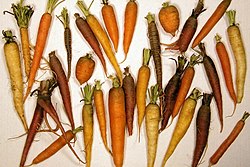
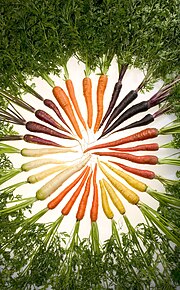
The carrot (Daucus carota subsp. sativus, Etymology: Middle French carotte, from Late Latin carōta, from Greek karōton, originally from the Indo-European root ker- (horn), due to its horn-like shape) is a root vegetable, usually orange, purple, red, white, or yellow in colour, with a crisp texture when fresh. The edible part of a carrot is a taproot. It is a domesticated form of the wild carrot Daucus carota, native to Europe and southwestern Asia. It has been bred for its greatly enlarged and more palatable, less woody-textured edible taproot, but is still the same species.
It is a biennial plant which grows a rosette of leaves in the spring and summer, while building up the stout taproot, which stores large amounts of sugars for the plant to flower in the second year. The flowering stem grows to about 1 metre (3 ft) tall, with an umbel of white flowers that produce a fruit called a mericarp by botanists, which is a type of schizocarp.

Uses and nutrition

Carrots can be eaten in a variety of ways. The simplest way is raw as carrots are perfectly digestible without requiring cooking. Alternatively they may be chopped and boiled, fried or steamed, and cooked in soups and stews, as well as baby and pet foods. A well known dish is carrots julienne. Grated carrots are used in carrot cakes, as well as carrot puddings, an old English dish thought to have originated in the early 1800s. The greens are edible as a leaf vegetable, but are rarely eaten by humans, as they are mildly toxic. Together with onion and celery, carrots are one of the primary vegetables used in a mirepoix to make various broths.
Carrot flowers
Ever since the late 1980s, baby carrots or mini-carrots (carrots that have been peeled and cut into uniform cylinders) have been a popular ready-to-eat snack food available in many supermarkets.
Carrot juice is also widely marketed, especially as a health drink, either stand-alone or blended with fruits and other vegetables.
The carrot gets its characteristic and bright orange colour from β-carotene, which is metabolised into vitamin A in humans when bile salts are present in the intestines.Massive overconsumption of carrots can cause carotenosis, a benign condition in which the skin turns orange. Carrots are also rich in dietary fibre, antioxidants, and minerals.
Lack of Vitamin A can cause poor vision, including night vision, and vision can be restored by adding Vitamin A back into the diet. An urban legend says eating large amounts of carrots will allow one to see in the dark. The legend developed from stories of British gunners in World War II who were able to shoot down German planes in the darkness of night. The legend arose during the Battle of Britain when the RAF circulated a story about their pilots' carrot consumption as an attempt to cover up the discovery and effective use of radar technologies in engaging enemy planes, as well as the use of red light (which does not destroy night vision) in aircraft instruments. It reinforced existing German folklore and helped to encourage Britons—looking to improve their night vision during the blackouts—to grow and eat the vegetable.
Ethnomedically, the roots are used to treat digestive problems, intestinal parasites, and tonsillitis or constipation.

History

A basket of carrots displayed in a Singapore supermarket.
Workers harvesting carrots, Imperial Valley, California, 1948
The wild ancestors of the carrot are likely to have come from Afghanistan, which remains the centre of diversity of D. carota, the wild carrot. Selective breeding over the centuries of a naturally-occurring subspecies of the wild carrot, Daucus carota subsp. sativus reducing bitterness, increasing sweetness and minimizing the woody core, has produced the familiar garden vegetable.
In early use, carrots were grown for their aromatic leaves and seeds, not their roots. Some relatives of the carrot are still grown for these, such as parsley, fennel, dill and cumin. The first mention of the root in classical sources is in the 1st century CE. The modern carrot appears to have been introduced to Europe in the 8-10th centuries;. The 12th c. Arab Andalusian agriculturist, Ibn al-'Awwam, describes both red and yellow carrots; Simeon Seth also mentions both colours in the 11th century. Orange-coloured carrots appeared in the Netherlands in the 17th century. These, the modern carrots, were intended by the antiquary John Aubrey (1626-1697) when he noted in his memoranda "Carrots were first sown at Beckington in Somersetshire Some very old Man there [in 1668] did remember their first bringing hither."
In addition to wild carrot, these alternative (mostly historical) names are recorded for Daucus carota: Bee's-nest, Bee's-nest plant, Bird's-nest, Bird's-nest plant, Bird's-nest root, Carota, Carotte (French), Carrot, Common carrot, Crow's-nest, Daucon, Dawke, Devil's-plague, Fiddle, Gallicam, Garden carrot, Gelbe Rübe (German), Gingidium, Hill-trot, Laceflower, Mirrot, Möhre (German), Parsnip (misapplied), Queen Anne's lace, Rantipole, Staphylinos, and Zanahoria.

Cultivars

Carrots come in a wide variety of shapes and sizes.
Carrot cultivars can be grouped into two broad classes, eastern carrots and western carrots. More recently, a number of novelty cultivars have been bred for particular characteristics.
The world's largest carrot was grown in Palmer, Alaska by John Evans in 1998, weighing 8.6 kg (19 lb).
The city of Holtville, California promotes itself as "Carrot Capital of the World", and holds an annual festival devoted entirely to the carrot.

Eastern carrots

Eastern carrots were domesticated in Central Asia, probably in modern-day Afghanistan in the 10th century, or possibly earlier. Specimens of the eastern carrot that survive to the present day are commonly purple or yellow, and often have branched roots. The purple colour common in these carrots comes from anthocyanin pigments.

Western carrots

Carrots with multiple taproots (forks) are not specific cultivars but are a byproduct of damage to earlier forks often associated with rocky soil.
The western carrot emerged in the Netherlands in the 17th century, its orange colour making it popular in those countries as an emblem of the House of Orange and the struggle for Dutch independence. The orange colour results from abundant carotenes in these cultivars. While orange carrots are the norm in the West, other colours do exist, including white, yellow, red, and purple. These other colours of carrot are raised primarily as novelty crops.
The Vegetable Improvement Center at Texas A&M University has developed a purple-skinned, orange-fleshed carrot, the BetaSweet (also known as the Maroon Carrot), with substances to prevent cancer, which has recently entered very limited commercial distribution, through J&D Produce of Edinburg TX. This variety of carrot is also known to be high in β-carotene which is an essential nutrient. The high concentrations of this nutrient give the carrot its maroon shade.
Western carrot cultivars are commonly classified by their root shape:
  • Chantenay carrots are shorter than other cultivars, but have greater girth, sometimes growing up to 8 centimetres (3 in) in diameter. They have broad shoulders and taper towards a blunt, rounded tip. They are most commonly diced for use in canned or prepared foods.
  • Danvers carrots have a conical shape, having well-defined shoulders and tapering to a point at the tip. They are somewhat shorter than Imperator cultivars, but more tolerant of heavy soil. Danvers cultivars are often puréed as baby food. They were developed in 1871 in Danvers, Massachusetts.
  • Imperator carrots are the carrots most commonly sold whole in U.S. supermarkets; their roots are longer than other cultivars of carrot, and taper to a point at the tip.
  • Nantes carrots are nearly cylindrical in shape, and are blunt and rounded at both the top and tip. Nantes cultivars are often sweeter than other carrots.
Carrots can be selectively bred to produce different colours.
While any carrot can be harvested before reaching its full size as a more tender "baby" carrot, some fast-maturing cultivars have been bred to produce smaller roots. The most extreme examples produce round roots about 2.5 centimetres (1 in) in diameter. These small cultivars are also more tolerant of heavy or stony soil than long-rooted cultivars such as 'Nantes' or 'Imperator'. The "baby carrots" sold ready-to-eat in supermarkets are, however, often not from a smaller cultivar of carrot, but are simply full-sized carrots that have been sliced and peeled to make carrot sticks of a uniform shape and size.
Carrot flowers are pollinated primarily by bees. Seed growers use honeybees or mason bees for their pollination needs.
Carrots are used as food plants by the larvae of some Lepidoptera species, including Common Swift, Garden Dart, Ghost Moth, Large Yellow Underwing and Setaceous Hebrew Character.

Novelty carrots

Food enthusiasts and researchers have developed other varieties of carrots through traditional breeding methods. Novelty carrots are also grown throughout Western Europe in flower pots and are noted for their distinctly minty flavour.
One particular variety lacks the usual orange pigment from carotenes, owing its white colour to a recessive gene for tocopherol (Vitamin E). Derived from Daucus carota L. and patented (US patent #6,437,222) at the University of Wisconsin–Madison, the variety is intended to supplement the dietary intake of Vitamin E.

Monday, October 5, 2009

Potatto

The potato is a starchy, tuberous crop from the perennial Solanum tuberosum of the Solanaceae family (also known as the nightshades). The word potato may refer to the plant itself as well. In the region of the Andes, there are some other closely related cultivated potato species. Potatoes are the world's fourth largest food crop, following rice, wheat, and maize. Long term storage of potatoes requires specialised care in cold warehouses and such warehouse are among the oldest and largest perishable storages in the world.
Wild potato species occur from the United States to Uruguay and Peru.Genetic testing of the wide variety of cultivars and wild species suggest that the potato has a single origin in the area of southern Peru, from a species in the Solanum brevicaule complex. Although Peru is essentially the birthplace of the potato, today over 99% of all cultivated potatoes worldwide are descendants of a subspecies indigenous to south-central Chile. Based on historical records, local agriculturalists, and DNA analyses, the most widely cultivated variety worldwide, Solanum tuberosum ssp. tuberosum, is believed to be indigenous to the Chiloé Archipelago where it was cultivated as long as 10,000 years ago.
Introduced to Europe in 1536, the potato was subsequently conveyed by European mariners to territories and ports throughout the world. Thousands of varieties persist in the Andes, where over 100 cultivars might be found in a single valley, and a dozen or more might be maintained by a single agricultural household. Once established in Europe, the potato soon became an important food staple and field crop. But lack of genetic diversity, due to the fact that very few varieties were initially introduced, left the crop vulnerable to disease. In 1845, a plant disease known as late blight, caused by the fungus-like oomycete Phytophthora infestans, spread rapidly through the poorer communities of western Ireland, resulting in the crop failures that led to the Great Irish Famine. The potato was the first vegetable inherited by the early Australians, the Aborigines.
The annual diet of an average global citizen in the first decade of the twenty-first century would include about 33 kg (or 73 lb) of potato. However, the local importance of potato is extremely variable and rapidly changing. It remains an essential crop in Europe (especially eastern and central Europe), where per capita production is still the highest in the world, but the most rapid expansion over the past few decades has occurred in southern and eastern Asia. China is now the world's largest potato producing country, and nearly a third of the world's potatoes are harvested in China and India.More generally, the geographic shift of potato production has been away from wealthier countries toward lower-income areas of the world, although the degree of this trend is ambiguous.